

It may not be the technical words. It may be the ordinary ones.
Recently, I attended several online presentations given by veterinary professionals. The topics were interesting, and the speakers were clearly experts. They knew their subject deeply.
And yet, a few days later, I realised that what I remembered most was not what they had said. It was how hard it had been for them to say it.
I want to be clear: I admired them. Presenting complex work in a second language, in front of other experts, is not easy. But the experience made me think. If I, a willing and interested listener, remembered the struggle more than the science, what does that mean for the speakers who worked so hard to prepare?
But my audience are experts!
Let’s begin with something important: nobody is suggesting that you stop using technical terminology.
If you are speaking to fellow specialists, terms like “environmental enrichment” or “stereotypic behaviour” are the fastest and most accurate way to communicate. Replacing them with vague everyday words would make your presentation worse, not better.
It is also worth saying that the well-known research on jargon, including the work of Hillary Shulman and her colleagues that I reference below, was mostly done with non-specialist readers. In those studies, jargon made science feel harder to process, and adding definitions did not fix the problem. But that is not the situation we are discussing. Your audience understands your terms.
So if the terminology is not the problem, what is?
The Words between the Words
Think about how much of a presentation is actually technical vocabulary. Analyses of large collections of English texts suggest that ordinary, high-frequency words make up the large majority of what is written and said. In fact, it is roughly three-quarters or more! Think of it this way: your technical terms are the headlines. But a news story with only headlines would be very short, and not very informative.
The story that contains your technical words is actually told by the ordinary words: we looked into, it turned out, we came across, we took into account, this is likely to, it made a difference, etc. These small expressions connect your terms into an explanation. They show how one idea leads to another.
Here is a pattern I suspect is more common than we admit. Professionals like you, who are working in English, know their technical vocabulary very well. They learned it from research papers, conferences and professional discussions. Those words are fixed and precise, and they mean the same thing every time. Ordinary expressions are different. They are flexible. They change shape depending on the sentence, and using them naturally takes a different kind of knowledge. So when the moment comes to explain an idea, not just name it, the speaker may suddenly find the ordinary words harder to reach than the technical ones.
Now, let me be honest about what the research does and doesn’t show. Studies of university and pre-medical students learning in English have found that difficulties with everyday vocabulary, not only technical vocabulary, can make scientific material harder to understand. One study of learners in a university English programme found that many had not mastered the most common words in academic spoken English, even though these words are so important. But these studies looked at students, and at understanding rather than speaking. Nobody, as far as I know, has measured exactly what happens to a practising professional in the middle of a presentation. So treat this as a well-founded observation, not a proven law. It does, however, challenge a comfortable assumption: that someone who can use specialist vocabulary must be equally comfortable with everyday English.
What Your Audience is Doing while You Search for Words
Now think about the listener. Cognitive load theory, developed by the psychologist John Sweller and his colleagues, starts from a simple and widely accepted idea: our working memory, the mental space where we process new information, has limited capacity. When it has to handle too many new things at once, understanding becomes harder.
I should say that this theory was developed to explain learning from instructional materials, not listening to conference talks. So what follows is a reasonable inference, not a finding. But it fits what I experienced. When a listener has to work to follow the speaker, waiting through long pauses, guessing at half-finished sentences, rebuilding an idea that arrived in pieces, some of their attention goes to following, and there is less left for understanding.
In my case, the delivery took more of my attention than it should have. And what takes your attention is, perhaps, what you remember.
This is why the old advice, “just know your subject really well,” is not enough. Knowing something yourself and helping someone else understand it are two different skills. Explaining a complex idea simply is often harder than explaining it in technical language. It does not require a smaller vocabulary. It requires more flexibility: choosing familiar verbs, giving an example, saying the same thing in a different way. In other words, it means simplifying the explanation without simplifying the science.
Back to the Idiom
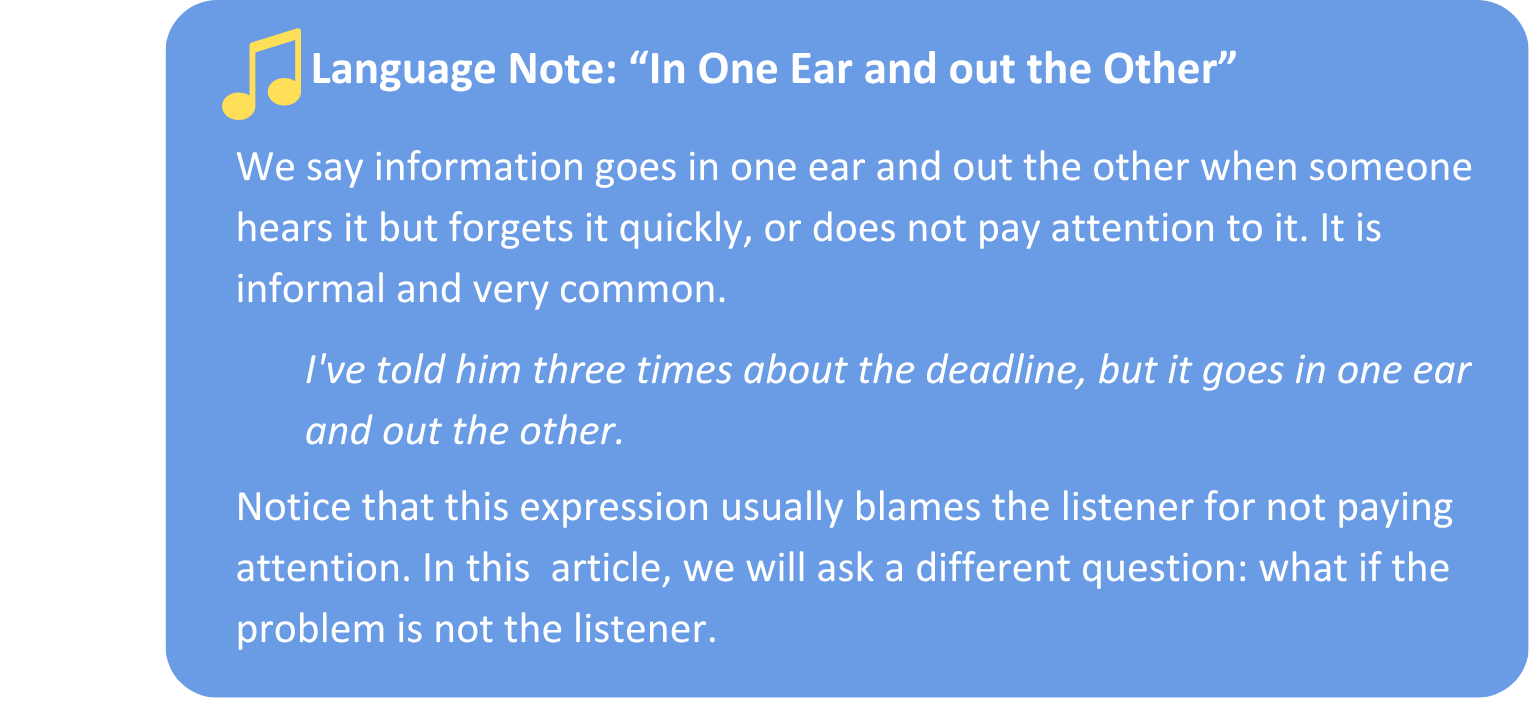
So let’s return to “in one ear and out the other.” When a presentation is forgotten, the usual explanation is that the audience wasn’t paying attention. Sometimes that is true. But sometimes the audience was paying attention, and the problem was how much work we asked them to do.
The Gap You Can’t See from the Inside
Here is the uncomfortable part. Most of us naturally steer around words we feel less sure of. It is a normal and useful communication strategy. But it means the gaps in your everyday English can become almost invisible, even to you. You don’t feel a missing word. You simply find another way around it, often back to the technical term you know well.
So you may not realise that your explanations lean on technical language because the ordinary alternative was harder for you. In addition, you also may not realise how much effort your audience spends following you.
You don’t need to remember everything you know. Your audience doesn’t need to either. They need to understand what matters, why it matters and what to take away. What they take away depends, more than most experts realise, on whether the ordinary words between the technical ones are working for you.
Knowing the words is not the same as communicating the idea.
If you would like to find out which ordinary words your explanations avoid, I would be happy to help you hear them.
____________________________________
Sources
Dang, T.N.Y., High-frequency words in academic spoken English: corpora and learners, ELT Journal, Volume 74, Issue 2, April 2020, Pages 146–155, https://doi.org/10.1093/elt/ccz057
Dang, T. N. Y., Webb, S., & Coxhead, A. (2022). Evaluating lists of high-frequency words: Teachers’ and learners’ perspectives. Language Teaching Research, 26(4), 617-641. https://doi.org/10.1177/1362168820911189.
Heming TA, Nandagopal S. Comparative Difficulties with Non-Scientific General Vocabulary and Scientific/Medical Terminology in English as a Second Language (ESL) Medical Students. Sultan Qaboos Univ Med J. 2012 Nov;12(4):485-92. https://doi.org/10.12816/0003175
Shulman, H. C., Dixon, G. N., Bullock, O. M., & Colón Amill, D. (2020). The effects of jargon on processing fluency, self-perceptions, and scientific engagement. Journal of Language and Social Psychology, 39(5-6), 579–597. https://doi.org/10.1177/0261927X20902177
Sweller, J., & Chandler, P. (1994). Why Some Material Is Difficult to Learn. Cognition and Instruction, 12(3), 185–233. https://doi.org/10.1207/s1532690xci1203_1
.