

What is really happening, and why the answer is not “Stop Translating in Your Head”!
You have just finished an international meeting. You followed everything that was said. You understood the data, the points and questions, and even the jokes (most of them!). You even had several good ideas of your own.
And yet, at the end of it, you feel as if you have run a small marathon.
Nobody asked you to carry anything heavy. You sat in a chair for an hour. But speaking English took so much effort that by the end, your brain felt like a laptop with forty browser tabs open. You may even have wondered: I have studied this language for years. Why is it still so much work?
If this sounds familiar, you are not imagining it, and you are not the only one to whom this happens. However, the explanation is more interesting than “my English isn’t good enough” or “I need to learn and practice more.”
The Invisible Process
When people describe what happens in their head before they speak English, the same story appears again and again. You have an idea, often in your first language. You look for the English words. You try to arrange them into a correct sentence. You check whether it sounds natural. And then, finally, you speak, often after the conversation has already moved on to the next topic.
Most people call this “translating in my head.” It is a good description of the feeling, but it is only part of the picture. The real process is more complicated, which often surprises people.
When you speak a second language, your first language does not leave the room politely. Studies of bilingual speakers have shown that both languages are active at the same time, even when you want to use only one. Words from both languages compete to be chosen, and your brain has to select the right one and keep the other quiet, in real time, while you are also thinking about your argument. Your first language can be managed, but it cannot be completely switched off.
Researchers have also described how the way we reach meaning in a second language changes over time. Beginners often connect new English words to their first-language equivalents. As you get better, you rely on those links less, because the English words connect more directly to ideas. But the links never fully disappear. As a result, it is not as simple as “translating” or “not translating.” Speaking in a second language is a bundle of tasks, and several of them are happening at once.
Why It Is Slower, Even for Strong Speakers
Here is something every international professional should know. Compared with speakers who speak only English (or only one language), bilingual speakers experience more “tip-of-the-tongue” moments. This is when you are sure you know a word but cannot retrieve it. Some studies have shown that when doing “picture-naming” tasks, bilinguals are also slower and less accurate than those who know only one language. And in free, spontaneous speech, research reports higher rates of hesitation, and more breaks in the flow of speech, in a second language than in a first.
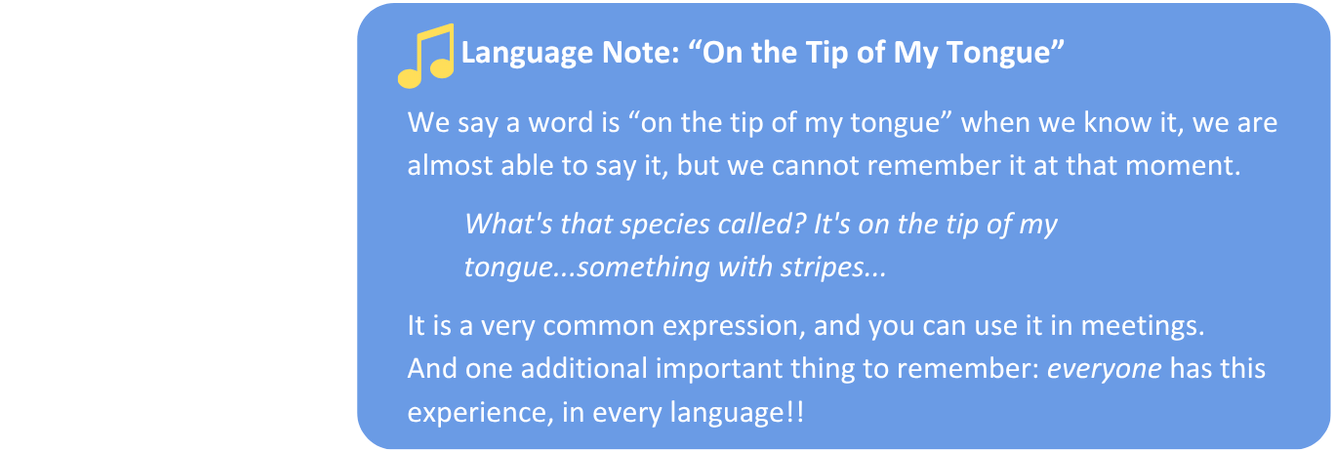
Researchers still debate exactly why this happens. One explanation is that if you divide your life between two languages, you use each word less often, so the connections to your words are a little weaker. Another is that the two languages interfere with each other. Whichever explanation is correct, the message is clear: the effort you feel is real, it is measured, and it is not evidence that you are a poor speaker.
So Why Doesn’t “Stop Translating” Work?
You have probably heard the advice: “Don’t translate! Think in English!” It is well meant. But for most professionals it is not very helpful, for three reasons.
First, you cannot switch your first language off. As we have seen, both languages are active. Telling yourself to stop is a little like telling yourself not to hear a radio that is playing in the next room.
Second, “translating” is not one job. It is several jobs with one name: deciding what to say, finding the words and building the sentence, and checking the result. Researchers who study speech describe these as separate stages. Each one can slow you down for a different reason, and each needs a different kind of help. “Stop translating” treats them all as one bad habit.
Third, and most important: attention is limited. In your first language, finding the words and building the sentence happen almost automatically. You never notice them. In a second language, researchers explain, the same steps often need conscious attention and effort, and they run more slowly until they become automatic. When so much attention is used just to produce the sentence, there is less left for everything else.
The Editor Working Overtime
This is where your inner editor comes in. Checking your own speech is completely normal. Speakers of every language do it, in their first language too. The problem is the cost.
Imagine writing an important email while proofreading every word as you type, with someone waiting for the answer. That is what an hour of meeting can feel like. The writer and the editor are using the same limited attention, and in English the writer already needs more of it. So the editor slows everything down: the pause before you begin, the restart, the sentence you abandon halfway because it didn’t sound quite right.
Where Does That Leave You?
Here is the difficult part. Two people can both say “speaking English is exhausting” and have completely different problems.
One person loses time deciding what to say. Another knows exactly what they want to say but gets stuck searching for the words. A third speaks fairly smoothly but keeps stopping to correct and rephrase. The advice that helps one of them may be no help at all for the others.
From the inside, you cannot easily tell which one you are, because it all feels like one single effort. But it leaves traces in your speech: where you pause, where you restart, which words you hesitate before. Researchers who study second-language speech use exactly these patterns, the pauses, the repairs and the restarts, to understand where speech is slowing down and why.
So the better question is not “How do I stop translating?” It is this: where, exactly, does my speaking slow down, and why there?
That question is often very hard to answer alone. It is much easier to answer when someone listens carefully.
At Intuitive English, the goal is not to make you stop using your first language in your head. As we have seen, that is not how the brain works. The goal is to help more of your English become automatic, so that your attention is free for what matters most: your ideas.
If you would like to find out where your own English slows down, I would be happy to listen .
____________________________________
Sources
Kroll, J. F., & Stewart, E. (1994). Category interference in translation and picture naming: Evidence for asymmetric connections between bilingual memory representations. Journal of Memory and Language, 33(2).
Gollan, T. H., & Acenas, L. A. (2004). What is a TOT? Cognate and translation effects on tip-of-the-tongue states in Spanish–English and Tagalog–English bilinguals. Journal of Experimental Psychology: Learning, Memory, and Cognition, 30(1).
de Jong, N. H., Groenhout, R., Schoonen, R., & Hulstijn, J. H. (2015). Second language fluency: Speaking style or proficiency? Correcting measures of second language fluency for first language behavior. Applied Psycholinguistics, 36(2).
Levelt, W. J. M. (1989). Speaking: From Intention to Articulation. MIT Press.
Kormos, J. (2006). Speech Production and Second Language Acquisition. Lawrence Erlbaum.