

You know your subject, because you have spent years working in it and studying it: the research, the evidence, the limitations, the arguments on both sides. Your colleagues may even come to you when they need an expert opinion. Then you find yourself in an international meeting, and someone turns to you and asks what you think. Suddenly, your answer sounds something like this:
“Well… I’m not completely sure, but I think perhaps we could…”
You do reach your point in the end. It is accurate and thoughtful, and it may even be the most useful contribution of the whole meeting. But somehow, it doesn’t sound like you. And that can be a problem, because there is often a real difference between how confident you are and how confident you sound in English.
Sounding Unsure is Not the Same as Being Unsure
Let’s be clear about one thing: sounding less confident does not mean you are less confident. You can have ten years of experience, know exactly what you are talking about, and still say, “I’m not sure if this is relevant, but perhaps…”
There are many possible reasons. You may be translating in your head, searching for the right word, or worrying about a grammar mistake. You may be trying to sound polite and professional, and politeness conventions differ between languages, so what sounds respectful in one can sound uncertain in another. And when so much attention goes into getting the English right, the message itself often becomes less direct.
What Your Listeners Actually Hear
This is a case of “more than meets the eye”. The person who says “I think perhaps…” may hold a very strong opinion. The person who takes a long time to answer may know the answer perfectly well and be searching for the right English. The person who keeps explaining may simply fear that the first explanation wasn’t clear enough.
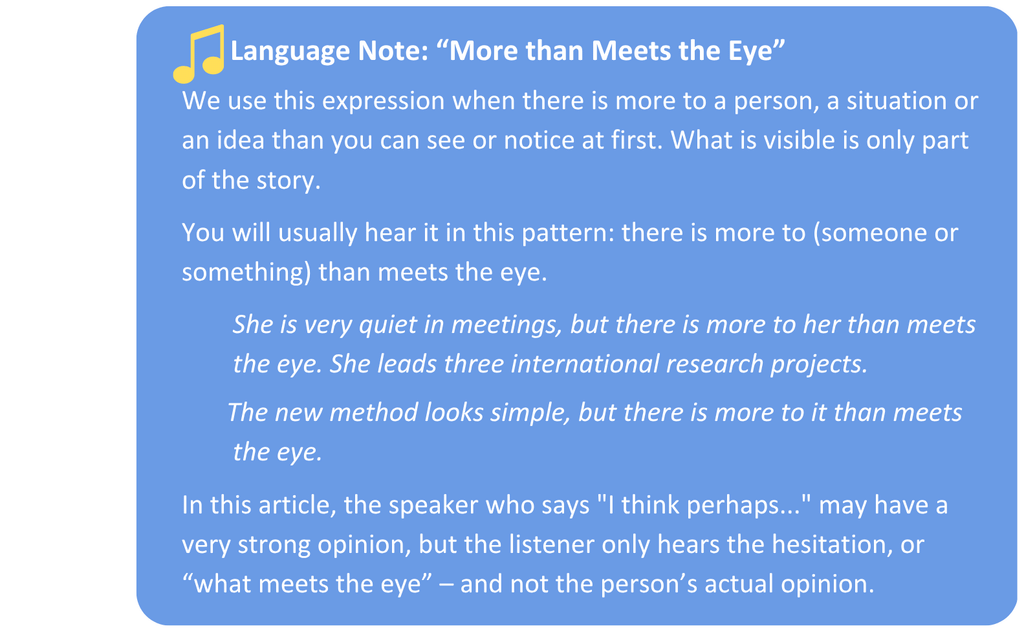
Your listeners, however, can’t see any of this. They do not know what is going on in the background. What they do hear your small pauses, the repeated explanation, the apologies. And from what they hear, they form an impression. That impression may not be fair, but it can still affect how people respond to you.
Researchers have studied situations that are related to this one, and the findings are worth knowing. In a well-known set of experiments, psychologists Shiri Lev-Ari and Boaz Keysar asked native English speakers to judge how true a series of trivia statements were. (For example: a giraffe can go without water longer than a camel can.) Statements spoken with a mild foreign accent were rated just as truthful as statements spoken by native speakers. But statements spoken with a heavy accent were rated as less truthful. The listeners were not aware they were doing it, and the researchers suggested an explanation: when speech is harder to process, people tend to trust it a little less.
An accent is not the same thing as hesitation, and nobody has tested this exact situation. Still, the finding points to something every international professional should know: listeners judge more than your words. They also judge, without realizing it, how easily those words reach them.
The Hidden Cost
This is where the problem becomes bigger than English. Imagine you have a valuable idea and you begin carefully: “I’m not sure if this would work, but perhaps we could consider…” A few minutes later, a colleague makes a similar suggestion, but presents it more directly, and the discussion moves forward with their idea.
This happens to everyone occasionally. (It has happened to me too, more than once!) But if it happens regularly, something more important may be going on: your ideas may be receiving less weight than they deserve.
Research on group behaviour shows how easily “sounding competent” and “being competent” can separate. Psychologists Cameron Anderson and Gavin Kilduff at UC Berkeley put small groups of students together to work on tasks. The students who spoke up assertively were rated by their teammates as more competent and more influential. In a follow-up task, where the researchers could check the actual answers, the people who emerged as leaders were not always the ones giving the most correct responses. It was a laboratory study with students, so we should not stretch it too far, but it shows how much listeners rely on what they hear (tone, delivery) when they cannot see what you know.
Over time, the costs can add up quietly:
Your expertise may be underestimated:
People cannot see everything you know. They see what you communicate.
You may be overlooked:
Opportunities often travel through conversation: who is invited to speak, who is asked to lead a project, who is trusted to represent the team, who is remembered after a conference. When several people have similar expertise, communication can decide who gets noticed.
You may start to participate less:
If you regularly feel that you sound less articulate in English than in your first language, it becomes tempting to skip the question, keep the opinion to yourself, or avoid starting a conversation at a conference. “I’ll say something when I know exactly how to express it,” you think. But by then, the moment has usually passed. Less speaking means less practice, less practice means less confidence, and less confidence means less speaking.
Note that this is not about changing your personality or “performing” confidence. It is simply a reminder that people form impressions quickly, and they only know what they see and hear.
So, Should You Simply “Sound More Confident”?
Not necessarily. I don’t think “just be more confident” is always very useful advice. And for scientists, it can even be wrong, because you should not sound more certain than the evidence allows. If your data show that something may happen, saying that it will happen just to sound stronger is not good science.
Good scientific communication needs appropriate uncertainty. The encouraging news is that honest uncertainty is not as risky as many experts fear. In a series of five experiments with almost 5,800 participants, including one on the BBC News website, researchers led by Anne Marthe van der Bles found that when uncertainty about facts was communicated, people did perceive the information as more uncertain, but their trust in the numbers and in the source fell only slightly. The small drop was seen mostly when the uncertainty was expressed in words rather than numbers, which is a good reminder that how you express uncertainty really matters.
Compare these two sentences:
> I’m not sure, but maybe this could possibly be one explanation.
> The evidence suggests that this may be one explanation.
Both express uncertainty. But the second communicates that the uncertainty comes from the evidence, not from a lack of confidence in the speaker. That is a very different message to a listener.
The goal, then, is not to sound more confident than you are. It is to make your actual level of knowledge, confidence and certainty clear to your audience.
What about You?
Think about the last time you spoke English in an important professional situation: a meeting, a presentation, a conference, a question after your talk.
Then ask yourself:
- Do I soften my opinions more in English than I would in my first language?
- Do I apologise before making a point?
- Do I say “I’m not sure…” even when I know the subject well?
- Do I keep explaining after I have already made my point?
- Do I change or abandon what I want to say because I cannot find the “perfect” English?
- Do I sometimes think of a much better answer several minutes after the conversation has finished? (If so, you are in good company. The French even have a phrase for it, l’esprit de l’escalier, the clever remark that comes to you on the stairs (l’escalier) after you have left.)
There is no need to judge yourself. Just notice.
The Gap You Can’t See from the Inside
You may believe your English problem is vocabulary, or grammar, or pronunciation. But sometimes the bigger issue is the gap between your expertise and the way that expertise is communicated, and that gap is surprisingly hard to see from the inside.
You know what you meant. You know how much you know. You know that you were nervous because the meeting was important, or that you were searching for a word, or that you were trying to be polite. Your audience has no access to any of that. They hear only the final version.
So perhaps the most useful question is not “What should I change?” but this one: what are people hearing that I am not aware of?
You don’t need to become a different person in English. You don’t need to sound like a native speaker. And you certainly don’t need to pretend to be more certain than you are. You need your communication to reflect the expertise, clarity and honest confidence you already have. When it doesn’t, the cost can be much greater than a few awkward sentences. It can affect whether people listen to your ideas, remember you, trust your judgement and see you as someone ready for the next opportunity.
And closing that gap usually begins with something simple: finding out what the gap actually is.
If you would like to hear your English from the other side of the table, that is exactly what we do at Intuitive English.
____________________________________
Sources
Lev-Ari, S., & Keysar, B. (2010). Why don’t we believe non-native speakers? The influence of accent on credibility. Journal of Experimental Social Psychology, 46(6), 1093–1096.
Anderson, C., & Kilduff, G. J. (2009). Why do dominant personalities attain influence in face-to-face groups? The competence-signaling effects of trait dominance. Journal of Personality and Social Psychology, 96(2).
van der Bles, A. M., van der Linden, S., Freeman, A. L. J., & Spiegelhalter, D. J. (2020). The effects of communicating uncertainty on public trust in facts and numbers.